

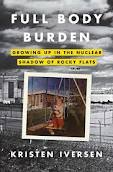
 The day before we left for our summer vacation—a week of hiking, rafting, swimming, and sight seeing in Colorado—a neighbor called me and said, “just make sure you don’t swim in Standley Lake.” As it turns out, Kristen Iversen had just been interviewed on NPR’s Fresh Air discussing her recent book about the Rocky Flats Nuclear Weapons facility and the overwhelming amount of contamination that was created over 50 years on and around the site. Much of which is still there today—in the soil, in the lake bed, in the water, and potentially even still in the air. And part of the Rocky Flats area is now set to be opened as a wildlife refuge for hiking, biking, and camping. But we aren’t supposed to be concerned about this because according to the Department of Energy and the Colorado Department of Public Health and Environment, “all contaminants are at levels that have been declared safe.” Never mind that countless engineers, scientists, doctors, environmentalists, and local citizens feel the site should be vacated and fenced off for eternity so that no human being will ever again come into contact with this area. But that’s kind of like ‘job killing regulation,’ I suppose. Far better to plant some trees, pave some bike paths and call it a wildlife refuge because then the real estate developers can sell adjacent land for houses, stores, and offices. And Stadley Lake can continue to be used for boating, fishing, and swimming despite the fact the the entire silt bed is full of plutonium. That’s why boating and swimming must only take place in the middle of the lake and not at the shore—wading, it turns out, could stir up the bottom and bring the plutonium to the top. Although apparently this plutonium, according to the DOE, is “not expected to be detrimental to one’s health.” If we can’t see it , smell it, or taste it, how could it possibly be dangerous??
Built in the early 1950’s, Rocky Flats is a sprawling complex located 19 miles West of Denver and 9 miles south of Boulder that produced plutonium “triggers” for atomic bombs. According to the author’s extensive research, each trigger contains enough breathable particles of plutonium to to kill every person on earth. 70,000 of these triggers (nuclear fission bombs in themselves) were produced over a course of 35 years at Rocky Flats, the last ones in 1989. When trigger production ended, the plant stayed open for another 10 years, eventually changing its name in the mid 1990’s to the Rocky Flats Environmental Technology Site with a focus on how best to clean up the widespread contamination. At that point, the DOE estimated that it would take 70 years and $36 billion dollars to clean up the site, acknowledging that the technology for an adequate clean up might not even exist. But, viola! A private company was hired for $7.3 billion and said they could do the clean up in less than 10 years. Less than ten years! Needless to say, the DOE hired them, no doubt pleased that such a huge task could be done so quickly and so cheaply. Thankfully, as of now, the wildlife refuge has not been opened to the public mostly because the clean up has been so controversial.
This story flip flops back and forth between the history of Rocky Flats and Iversen’s own life story growing up just down the road, making it part memoir and part investigative journalism. It is very well researched and written. And incredibly compelling. Ignoring all other duties, I finished it in two days. This is a must read. (non fiction). Here’s the interview on NPR’s Fresh Air program:http://www.npr.org/2012/06/12/154839592/under-the-nuclear-shadow-of-colorados-rocky-flats.
Discover more from Bean's Book Blog
Subscribe to get the latest posts sent to your email.
