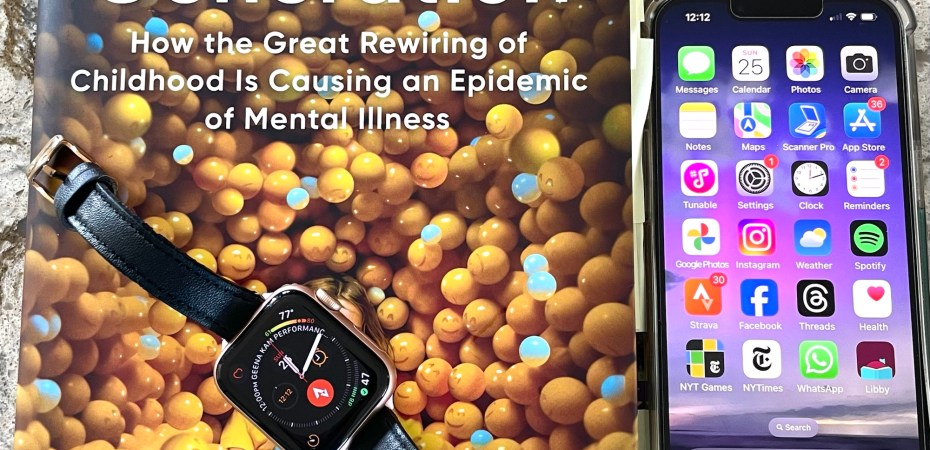
I’ve been reading this book alongside others because I have to keep putting it down. It’s so depressing–at least in part because I’ve witnessed everything he writes about, but I did not have the words or the research to support my gut feelings until about 5 or 6 years ago when I began to delve into articles tying mental health deterioration to phone based living, most prominently in Gen Z from 2010 to 2015, a time when smartphones and social media proliferated, but no one knew the extent of the negative impact. As a teacher and a parent, I saw it firsthand. Now, ten years later, we’re still grappling with a mental health crisis, and we’re still too hesitant to institute stricter rules and laws to prevent further destruction, even though we now understand the harm.
Jonathan Haidt lays out the problem, the research, and some achievable solutions, but they will take work and they will get pushback: tech companies need to enforce new rules, schools need to ban phones all day, and parents need to do a lot of things differently, including giving their kids a lot more independence in the real world earlier and a lot less independence online.
Life on a platform is me-centered, forcing young people to become “brand managers, always thinking about social consequences…every action becoming strategic” (54). Instead of living in “discover mode” looking for opportunities and growth, too many Gen Zers moved into “defend mode,” scanning for dangers, fearing judgment, and feeling traumatized by discomfort.
The smartphone, with all its apps and platforms, delivers “digital dopamine 24/7 for a wired generation,” sucking up time, sleep, focused attention, physical activity, and real social interaction. It also delivers more content than anyone can or should consume.
Surely other factors have contributed to the mental health challenges faced by Gen Z, but it’s hard to ignore smartphones as the “key culprit for the rapid transformation of childhood/adolescence from 2010 to 2015 when similar difficulties arose for Gen Z in so many other nations at the same time” (290).
This is a must-read, especially for parents and educators–we can still enact changes to stem the flow of harm.
Discover more from Bean's Book Blog
Subscribe to get the latest posts sent to your email.
