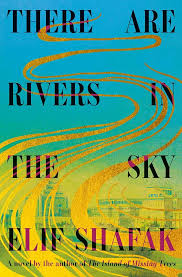
For several months, I have avoided multi-narrator/time/place books because so many feel “baggy” (not my word, The Guardian’s word, but it’s perfect): too much going on, too many coincidences, too many stories to force together thematically. The best of this multivoice genre includes Cloud Cuckooland, Hello Beautiful, and A Little Life. The weak ones include too many to list. Sadly, Elif Shafak’s There Are Rivers in the Sky joins the weak list. When a reviewer calls a book “ambitious,” I usually interpret that as “too much.” Though this book will likely be on every best-seller list based on its gushing August NYT review, I give it a meh, though there are definitely some positives.
The story begins in ancient Mesopotamia, in Nineveh near the Tigris River, under the rule of King Ashurbanipul—whose library includes the Epic of Gilgamesh on clay tablets. Fast forward to mid 1800s London on the River Thames where Arthur is born into abject poverty, but he will become a translator of the tablets. In 2014, Narin, a Yadizi girl living near the Tigris is getting baptized, but her grandmother wants to take her to Lalish, an ancient and revered city in war torn Iraq. Finally, our fourth protagonist is Zaleekhah, a hydrologist living in a houseboat on the Thames in 2019.
With water as its motif (and endless analogies), the story travels back and forth in time, river to river, among its protagonists where bright moments come to life, but overall so much exposition (telling rather than showing) bogs it down, and stilted dialogue artificializes (I don’t think that’s actually a verb) the characters.
But let me get to the bright spots: research for one. The deep dive into Assyrian culture, The Epic of Gilgamesh, translation of Cuneiform, and lamassu sculptures were some of the best parts. That and the 2014 genocide of the Yadizi people in Iraq by Islamic State militants, an event (I’m embarrassed to say) that I do not recall.
The biggest drawback here is trying to connect these narratives naturally instead of forcing them together. At one point, the connection between Narin and Zaleekhah’s stories borders on absurd. But at times, I was drawn into Arthur’s story, especially at his birth and during his early boyhood interest in the Lamassu carvings; at times, modern day Zaleekah, an orphan raised by her Middle Eastern uncle, interested me with her failing marriage and houseboat living; and Narin’s story of the Yadizis, a historically marginalized group, was most powerful as they are fleeing to Mt. Sinjar with ISIS attackers slaughtering most of them or later watching them die of starvation and dehydration. This scene led me to a whole lot of Wikipedia reading, including US airdrops of food and water.
Shafak’s research is thorough and credible, but maybe also her downfall as she tries to pack too much into the story, reminding me of nonfiction writers whose books are twice the length they should be.
The best part of this reading experience for me? I’ve picked up my old teaching copy of Gilgamesh and started rereading it. It’s been decades, and I thank Shafak and this novel for inspiring me to reread this 4,000-year-old literary work, the world’s oldest epic. More on that later.
Discover more from Bean's Book Blog
Subscribe to get the latest posts sent to your email.

You’re right, the research is very impressive. I knew the outlines of ISIS brutality against the Yazidis, but not the details, and Shafak really brought it to life in those sections with Narin. As you know, I share a lot of your views about the novel’s weaknesses, but it’s good to acknowledge the strengths.
It’s probably been decades since I read The Epic of Gilgamesh too! I think my copy is lost now, but I might buy a new one. In the meantime, I’ll read your post.
LikeLike