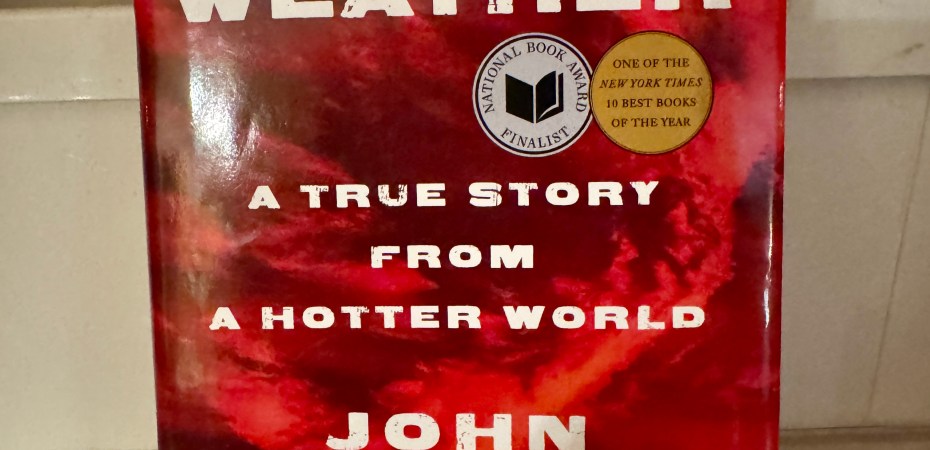
This book is fantastic: comprehensive, dense, detailed, devastating, and toward the end, slightly uplifting (I’ll get to that later). I couldn’t put it down, even though it covered a lot of ground.
Centering around the 2016 Fort McMurray wildfire in the Canadian tar sands of Alberta, Canada, Vaillant brings us into the middle of the conflagration that wiped out 2500 homes, evacuated 90,000 residents, and burned 25,000 square miles of forest over the next 14 months. As much as the details of the fire and its fighters are all consuming, it’s primarily a book about the meeting of forest and fossil fuels, with an in depth history of each, along with their impact on climate change.
Fort McMurray (known at its apex as Fort Money) is a sprawling city in the middle of boreal forests—-600 miles from the US border and 600 miles from the Arctic Circle—birthed from bitumen mining, the dirty, expensive, earth scarring process of extracting bitumen (basically asphalt) out of the tar sands to eventually become a form of crude oil. Specialized equipment like 100 ton bulldozers, behemoth shovels, and 400 ton dump trucks are needed for this mining. Not just a few but hundreds of them, some costing a million dollars each. According to the author, “there is no really comparison between the petroleum industry in northern Alberta and that of Texas or Saudi Arabia or any other place where oil is drawn from the earth by conventional means.” All of this—mines, machines, man—operate 24/7, 365 days a year, from -60° to +90° F. These are hardy, independent, money-driven people working in an intense, environmentally damaging industry.
In early May 2016 the weather was unusually dry, unseasonably hot (high 80s), and windy, yet no one was worried about the numerous small fires burning several miles away. But over the course of two days, with increased winds and a switch in direction, one fire (009) suddenly hit the SW corner of town, jumped the river, and burned all or part of nearly every residential community before most residents digested that it had arrived. Certainly no one could imagine the depth of destruction, even while looking at the towering flames and smoke coming directly at them. But Vaillant’s description of a forest fire makes it pretty clear: “able to self generate from a single spark, explode like a bomb, turn on a dime, and fly over obstacles, fire possesses an unparalleled capacity for random movement and rapid growth.”
Municipal firefighters are trained to put out building fires, not forest fires erupting into hurricane strength infernos of 1000°+ in multiple places. Known as WUI—wilderness urban interface—these are fires that cross over from forest to city and require completely different methods to contain. Add to that, this young, dense city was filled with cheaply built (but expensively priced) homes a mere 6 feet apart and garages filled with multiple vehicles and recreational toys, propane tanks, chemicals for a myriad of projects, all of which blew up like firebombs exploding while families were driving away in flames nearly melting their cars.
Yet Vaillant discloses that, even in the early 1980s, the oil industry (specifically the American Petroleum Industry) “thought it prudent to reevaluate their position on CO2, noting it was certain to have disastrous consequences” (270). But by 1984 it had abandoned its task force, working with Reagan on environmental rollbacks and forming a new organization, on behalf of the fossil fuel industry, “to cast doubts on climate science and “alarmists.”
And now, “it hardly needs to be said that more CO2 leads to more heat retention which leads to more fires which leads to more pyroCbs…” (298). Vaillant goes on to write “Currently we live in a dangerously bifurcated reality where senior executives at forward thinking, publicly traded global companies like Exxon, Shell, JP Morgan, and the Bank of England accept the science of anthropogenic carbon dioxide and the threat it poses, and still continue to—literally—pour gas on the flames” (340).
In 2019, Ben van Beurden, Shell’s CEO, said in a Time magazine interview, “yeah, we knew. Everybody knew” referring to the way the oil industry manipulated governments and mislead the public regarding the impact of industrial CO2. By 1980 the science was effectively confirmed, van Beurden adds, and then, vehemently denied.
But remember, I said this book offered hope/uplifting information.
Finally, today some of the biggest asset management firms, pension funds, and insurance companies are divesting from fossil fuels. None can deny that supporting an industry wreaking havoc on people and the environment is no longer a morally viable investment. The International Energy Agency issued a “net zero by 2050…which will require nothing short of the complete transformation of the global energy system…if the future is to be livable, it will be powered by carbon-neutral energy.”
I’m not sure that will actually happen, especially with our current American administration, but if international asset managers divest from fossil fuels, that’s some firepower that offers hope.

A pink and purple sunset over Lake Michigan during the Canadian Jasper Fire in 2024
pc: Simply Laurie Photography
Discover more from Bean's Book Blog
Subscribe to get the latest posts sent to your email.
