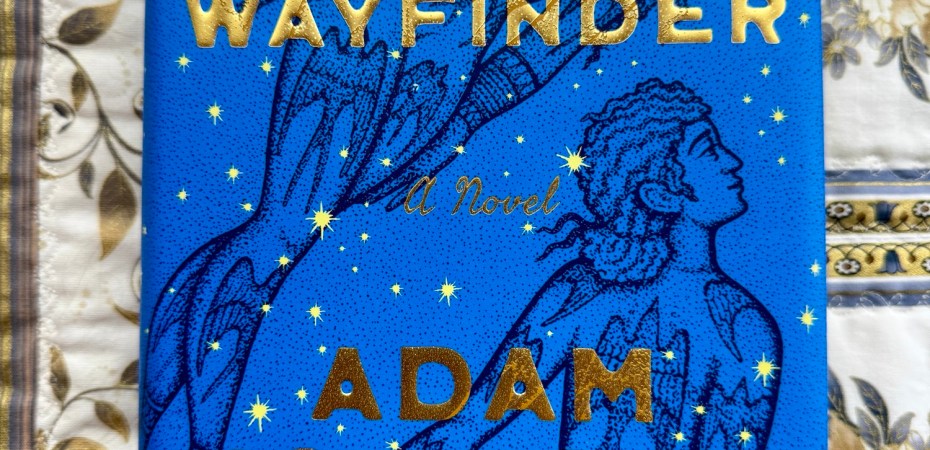
At over 700 pages, this book has been referred to as a Polynesian Odyssey in reference to Homer’s epic, with many common features: warfare, power, royalty, loyalty, servitude, sea travel, oral history, obsession with the afterlife and its physical place (Pulotu), magical realism (in this case talking birds, a wafting fan, souls stored in coconuts), and even epic simile (“Atop the cliffs, he felt vacant, as when a bonito has fallen victim to a fish-calling song, leaving it alive but dull-eyed”). And certainly this book has the overall epic journey feel to it as one island culture fights for survival and another island culture fights to establish peace.
Taking place in pre-colonial Polynesia (somewhere in the 1300-1500’s?), there are two storylines that intersect early on and intertwine throughout the novel. One centers on Korero and her people who are starving on a depleted island in the “Southern Sea.” They are descended from the Maori of Aotearoa (Today’s New Zealand), and are likely based on the real-life Moriori people of the Chatham Islands. They live peacefully, abide by population control, and feel marooned on their small island with no trees in which to build waku (canoes).
The other story centers on the Tongan Empire and its royal family: the Tu’itonga (king), the powerful Tomaha (elder aunt), the 3 sons (Lolohea, the Wayfinder, and Finau, the poet) as well as the many chiefs, Matapule, and security forces maintaining its power.
Two of the princes-–the wayfinder (navigator) and the poet—show up on Korero’s island, and slowly, she learns of their travails in seeking a peaceful future for Tonga among a ruthless father (he harms from afar) who keeps all of Tonga at War with Fisi (Fiji) and an uncle who is a damaged war veteran violating young women.
Like all epics, some of the big questions center on who has power and resources and who does not. And more important, what does each do with this power or lack of power?
Like Homer’s epic, there are historical truths here such as Tonga’s war culture and civil unrest of the 1400s, the stories of indigenous people before Western contact, the make up of the islands and waters of the South Pacific, the descendants of the Maori in the Chatham Islands.
The author spent 10 years writing this book, starting with his interaction with the Maori community in Auckland and his fascination with the extent to which their community can co-exist with the modern world. He also visited 14 of the Tongan islands. In each place, he gathered stories, histories, myths, and values of the cultures.
While the book sometimes feels a bit longer and more complex than it needed to be, so much is beautifully written. I think perhaps his most powerful writing is in the death scenes where we relive in great detail the last moments of human life. They are stomach-churning but necessary to understand the expectations and sacrifices of cultural tradition.
It is also necessary to often reference the character list and the map in the front of the physical book. It’s a lot to keep track of, though eventually, the characters become clear, even while the time frames of the two stories can feel a bit blurry.
This book just came out mid October, and I’m happy to have purchased it right away. Thank you to my sister Laurie for sending me the recommendation/review.
It’s a reading journey worthy of your time!
Discover more from Bean's Book Blog
Subscribe to get the latest posts sent to your email.

Hello, Bean. I am a friend of your sister, Laurie. She shared your Blog with me several months ago and I am now a huge fan. Your reviews and your writing style are exceptional. Most of all, I look forward to being enlightened by your choices and appreciate their diversity and depth. You have developed an outstanding resource for serious readers and I for one am so very grateful. On another note, I just finished a book that is usually not a genre I would select but the author is Ian McEwan so I decided it might be very intriguing. “What We Can Know” has left me with so much to continue to think about. I may need to read it a second time – there is so much within. I have been disappointed by many of the fiction offerings in recent years. I now prefer non-fiction. That said, would value your reaction/review of this book because I am still getting my head around it. All the best to you and thank you so much for adding to my life with the magical Bean’s Blog. Thank you, Kimberly O.
LikeLike
Hi Kimberly. I purchased What we can Know several weeks ago, so I will read it soon, but in the meantime, I had ordered four books from the library so now I feel compelled to read those first so that I can return them. Thanks for your comment!
LikeLike