
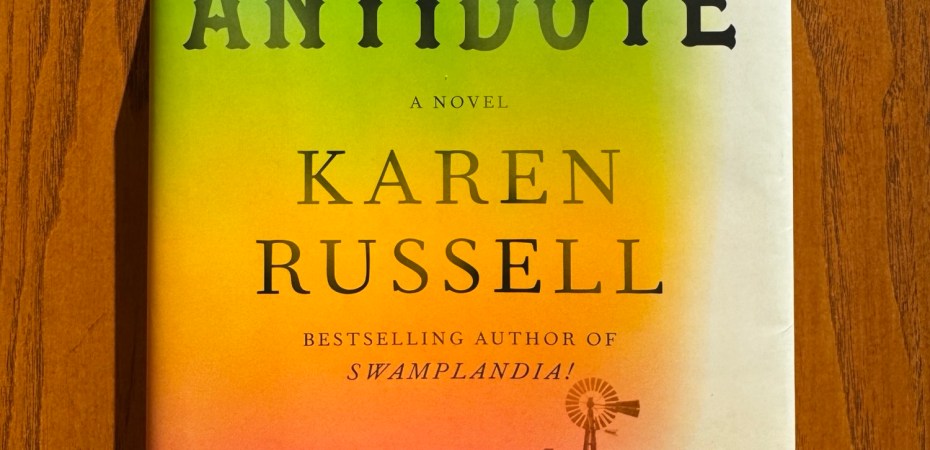
This book has a LOT going on, and much of it is unique and intriguing. Taking place in 1935 central Nebraska and bookended by two catastrophic and real events—the Black Sunday dust storm and the great flood of the Republican River—it’s a mix of historical fiction and magical realism that’s kind of cool, even inventive as in the case of a Graflex camera that sometimes produces images set in the past or future rather than the present, though the physical location is the same.
The main storyline–if there is a main one–revolves around a prairie witch named the antidote. She is a vault, taking deposits from humans who wish to unload their secrets or burdensome emotions so they can move on with their lives unencumbered. Sort of like therapy, except that you leave with none of the baggage weighing you down because now someone else is carrying it, and all you have is a deposit slip which you may or may not choose to redeem later in life. Some folks even deposit happy events that they want the vault to remember for safekeeping. The antidote is also a traumatized woman whose infant son was taken from her at a home for unwed mothers when she was a teenager.
There are several other main characters and storylines as well. Harp is a 2nd generation immigrant farmer whose land is somehow magically protected from the drought and dust. His teenage niece Dell has lived with him since her mother was murdered, and she’s holding together the local high school’s champion basketball team. Cleo is a Black single woman and a professional photographer sent to the Western Plains to capture photos that may help promote funding for the New Deal (but only if the photos show White people struggling).
Each of these characters is a narrator and each has their own storyline and subplot (there’s also a corrupt sheriff, though he’s not a narrator). Adequately threading them together into a cohesive story is the challenge here, and Russell didn’t do enough to successfully execute it. The book is already too long, and a better editor should have cut its scope. There’s just too much going on, too much left unresolved, and too little clarity on what the main story is, though it seems to be that these primarily Polish immigrants were given Pawnee land to farm, profiting from the Native population just as Germans and Austrians profited from and persecuted these same Poles back in their homeland.
But would these hungry, defeated mid 1930s immigrants fighting dust have the insight of modern, educated liberals? A scene near the end with Harp lecturing his fellow farmers actually sounds like 2025 performative activism.
There’s definitely a powerful story buried here, as well as some excellent writing and inventive ideas. And much of the time, I did like reading this book. But too much extraneous stuff swirling around clogged its focus.
Kind of like a dust storm.
Discover more from Bean's Book Blog
Subscribe to get the latest posts sent to your email.
